
The short version
- A ring works through fit alone. There is no motor or design that compensates for the wrong diameter, which is why sizing is the whole decision.
- Measure the inner diameter, not the outer. Stretch silicone should go on with mild effort and stay put without sliding.
- Numbness, tingling or a colour change means it comes off immediately — that rule overrides every measurement.
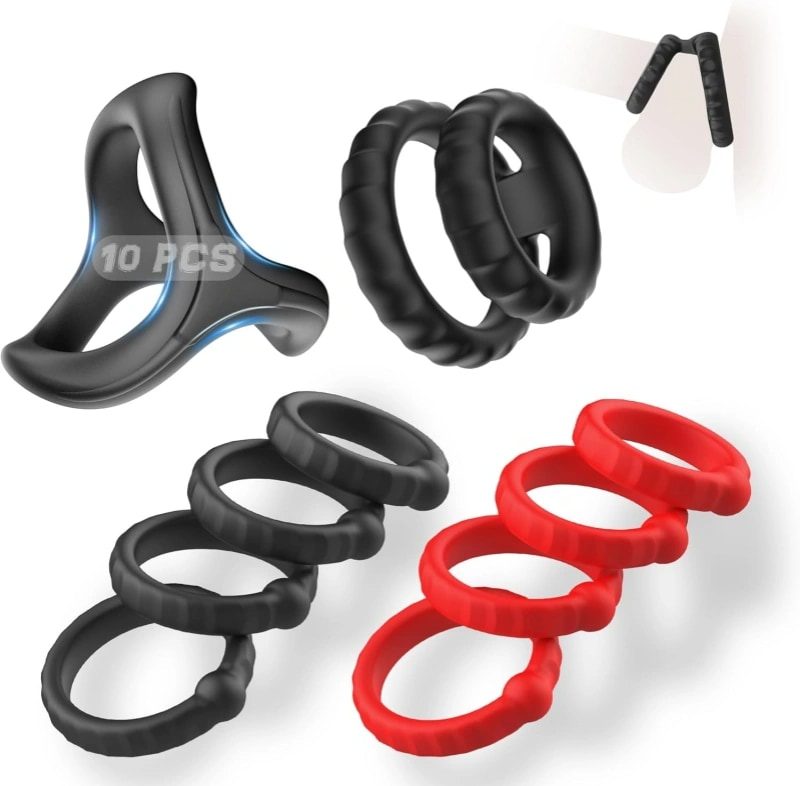
- Five common shapes: single stretch ring, double loop, triple arm, ring-plus-motor, and a multi-size set for finding your fit.
- Material decides the rest: silicone stretches and forgives, metal does not stretch at all and must be measured more carefully.
A cock ring is one of the simplest things we sell, and also one of the easiest to buy wrong. It has no settings, no modes and nothing to configure. Everything it does comes from how it fits at the base, which means the single number that decides whether you have a useful ring or a drawer ornament is the inner diameter.
This page covers the five shapes we stock, how each one is measured, what distinguishes a stretch fit from a rigid one, and the two physical signals that mean a ring should come off right now. It does not cover how to use one during sex — that is a different conversation, and this page stays on product facts.
The five shapes, and what each one actually is
Almost every ring sold falls into one of five groups. The groups differ in how they hold, not in how strong they are. Two rings of the same diameter can behave differently if one wraps a single band and the other wraps two loops.
| Shape | How it holds | Measured by | Best if |
|---|---|---|---|
| Single stretch ring | One band around the base | Inner diameter, stretched | First ring, or unsure of size |
| Double loop | One loop at the base, one behind | Two inner diameters | You want less movement |
| Triple arm | Three points of contact, no motor | Not listed — stretch only | You dislike bulk and batteries |
| Ring plus motor | Band with a housing on top | Inner diameter + housing width | Shared vibration matters to you |
| Sized set | Several fixed diameters | Each ring listed separately | You want to find your size once |
The table is a starting point, not a ranking. A single stretch ring in the right diameter does more than a double loop in the wrong one. Shape decides how the ring sits; diameter decides whether it works at all.
Single stretch ring: the default first purchase
One band, one diameter, made from a material that stretches. This is what most people picture when they hear the term, and for a first purchase it is usually the right shape. The reason is not that it is better — it is that a stretch material tolerates being slightly off, where a rigid ring does not.
Stretch silicone gives in a way that metal and hard plastic cannot. A band that lists a resting inner diameter will open considerably wider while going on, then settle back. That give means a ring a millimetre or two either side of ideal still functions, which matters when nobody measures their own diameter accurately the first time.
What stretch does not fix
Stretch tolerates a slightly loose fit far better than a slightly tight one. If a ring has to be worked on with effort, a stretchier version of the same diameter will not solve it — a larger diameter will.
Material matters here more than anywhere else in this category, because the band sits against skin for the whole session. Silicone is the common choice: it is non-porous, it rinses clean, and it does not hold odour the way softer porous compounds do. The trade-off is that silicone is also the material most likely to pick up lint and dust between uses, so storage matters.
Double loop: two diameters, one decision
A double loop wraps in two places instead of one. The practical effect is less movement: a single band can shift along the shaft, and a second loop anchors it. The cost is that you now have two diameters to get right instead of one, and the two are rarely the same size.
On every double loop we stock, both loops are moulded from one piece of material rather than being two rings joined together. That matters because a joined pair can rotate independently and pinch at the join. A single moulding cannot.
Double loops are usually listed with two inner figures, or with one figure and a note that the second loop is larger. When a listing shows only one diameter for a double loop, read that number as the smaller loop and expect the second to be larger.
Triple arm: three contact points, no motor
The triple arm design uses three separate arms from a central moulding rather than continuous bands. This distributes contact across three points, which some people find more comfortable than a single band pressing in one place, and it removes the bulk a motor housing adds.
Because there is no battery, charging port or control housing, the whole object is the same soft material. Nothing needs charging, nothing needs a port kept dry, and the entire ring rinses clean. For anyone who does not want to manage another device, this removes every maintenance step that a motorised ring adds.
The limitation is measurement. A three-arm design often has no listed diameter at all, because the arms open and close rather than forming a fixed circle. What the supplier sheet describes instead is stretch: how far it pulls from resting length and whether it returns. Where no diameter is printed, fit is judged by how it goes on, not by a number.
Ring plus motor: what the housing changes
Adding a motor changes three things at once: the ring becomes a device with a charging routine, the housing adds width at the top, and the diameter is usually listed more carefully because the housing restricts stretch.
The housing width is the figure most often overlooked. A band 15 mm wide and a band 70 mm wide can share the same inner diameter and still feel completely different, because a wider band spreads pressure over more area. When comparing two rings, compare both the inner diameter and the band width.
Charging method is worth checking before purchase rather than after. Magnetic contacts on the outside of a housing are common and avoid the weak point of a covered port, but they also mean the contacts must be dry before charging. A ring that is rinsed after every use needs that step built into the routine from day one.
Waterproofing is a rating, not a claim
A ring labelled IPX7 has been rated for brief immersion. That is different from "waterproof" with no rating attached. If a listing gives no IP figure, treat it as splash-resistant only and keep it out of the bath.
Sized sets: the honest way to find your fit
A set of rings in ascending diameters solves the measurement problem in the most direct way available: you try one, you know. Instead of guessing a single number and living with it, you work through a few and keep the one that behaves correctly.
Sets also let you compare shapes. A ten-piece set typically includes single rings in several diameters plus one or two multi-loop designs, so the same purchase answers both "what size am I" and "do I prefer one loop or two". For a first purchase, that is more information than any single ring provides.
The trade-off is that you end up owning rings you will not use. If you already know your diameter, a set is wasted value. If you do not, a set is cheaper than buying three rings to find out.
How to read the size figures on a listing
Listings carry three different numbers and they are not interchangeable. Reading the wrong one is the most common reason a ring arrives and does not work.
| Figure | What it measures | Use it for |
|---|---|---|
| Inner diameter | The opening the body goes through | The only number that decides fit |
| Outer diameter | The whole ring, material included | Bulk and how it looks under clothing |
| Band width | How thick the band is | Pressure spread and comfort |
A ring listed as 70 mm outer and 45 mm inner is not a 70 mm ring. It is a 45 mm ring with 12.5 mm of material on each side. Buyers who order by the outer figure consistently end up with something far too large, because the outer number describes how much material there is, not how much room there is.
Where a listing shows only "one size, stretch fit" and no diameter, that is a real category rather than an omission. Highly elastic rings are sold as a single size because the material covers a wide range. The trade-off is that you cannot compare it numerically against a ring that lists a diameter, so the two are not directly comparable on paper.
Material: what stretches and what does not
The material decides whether a ring can be forgiving about size. It also decides how much cleaning you are signing up for.
| Material | Stretch | Cleaning | Note |
|---|---|---|---|
| Silicone | High | Rinse, air dry | Most forgiving; compare diameters directly |
| TPE / gel | Very high | Rinse, dry fully, dust | Porous — must be dried completely |
| Metal | None | Wipe or wash, dry | Must be measured accurately; no give |
| ABS (housing) | None | Wipe only | Control bodies and pods, not the band |
Silicone and TPE behave differently enough that they should not be treated as the same purchase. TPE is softer and stretches further, but it is porous — which means it holds moisture unless it is dried completely, and it needs occasional dusting to stop the surface going tacky. Silicone is firmer, non-porous, and tolerates being put away slightly less perfectly.
Metal is the material where measurement stops being a convenience and becomes a requirement. There is no give at all, so a metal ring that is one size too small will not go on, and one that is one size too large will not hold. This is not a reason to avoid metal — it is a reason to be certain of the diameter before ordering.
If you want the material question handled in more depth, including which lubricants degrade which compounds, there is a fuller material breakdown here
Cock ring size chart (mm and inches)
The table lists the diameters we actually stock, taken from each product listing rather than a general range. Inner diameter is the opening the body goes through, so that is the number to match; outer diameter only tells you how much material sits around it. Where a listing does not state a figure, the table says so instead of estimating.
| Ring | Inner diameter | Outer diameter | Band width |
|---|---|---|---|
| Set ring — 1st size | 28 mm (1.10 in) | not listed | not listed |
| Set ring — 2nd size | 30 mm (1.18 in) | not listed | not listed |
| Set ring — 3rd size | 35 mm (1.38 in) | not listed | not listed |
| Set ring — 4th size | 40 mm (1.57 in) | not listed | not listed |
| Set double-layer ring | 26 mm (1.02 in) | 35 mm (1.38 in) | not listed |
| Set Y-shaped ring | 40 mm (1.57 in) | not listed | not listed |
| Magnetic vibrating ring | 45 mm (1.77 in) | 70 mm (2.76 in) | 15 mm |
| Ribbed vibrating ring | 38 mm (1.50 in) | 72 mm (2.83 in) | 17 mm |
Read down the inner diameter column and you get the range this shop actually covers: 26 mm at the tight end through 45 mm. The stretch rings sit in the lower half and give roughly one size either way, which is why a set is the cheaper way to find your fit than buying single rings one at a time. A rigid band has no such give, so it has to match the measurement rather than sit near it.
The fitting rule that applies to every shape
Every recommendation on this page reduces to one procedure, and it is the same for a metal ring, a stretch band and a three-arm design. Put it on, wait, and read what the body does.
- 1 Put it on with mild effort. A stretch ring should roll over, not be forced. If it takes real effort, the diameter is too small.
- 2 Check movement. Once on, it should stay where it was placed. A ring that slides freely is too large to do anything.
- 3 Wait a short while and check for numbness, tingling or a colour change at the surface.
- 4 If any of those three appear, remove it immediately. Do not wait to see whether it settles.
- 5 If none appear and the ring stays put, the size is correct for this session.
The two signals that override every measurement
Numbness and colour change. Either one means it comes off straight away, regardless of what diameter the listing said or how correct the fit seemed a minute earlier. No measurement is worth overriding those two signals.
Five mistakes that account for most wrong purchases
- Buying by outer diameter. The outer figure includes the material; only the inner diameter describes the opening.
- Assuming a stretch ring will compensate for a tight fit. Stretch forgives loose, not tight.
- Ignoring band width. A 15 mm and a 70 mm band in the same diameter distribute pressure completely differently.
- Choosing a motorised ring first. The motor adds charging, a dry-contact routine and a wider housing — three things to manage before you know whether the size is right.
- Reading "one size" as a guarantee. It means the material covers a range, not that it fits every body in that range.
Cleaning and storage, by material
Cleaning a ring takes less time than cleaning any other item in this category, with one exception: a motorised ring has contacts that must stay dry, and that changes the routine.
Non-motorised silicone and metal rinse under warm water and air dry completely. TPE needs the same rinse plus a full dry and an occasional light dusting. Motorised rings need the band cleaned around the housing rather than submerged, and the contacts wiped dry before the ring goes back on charge.
Storage matters more than it seems. Silicone picks up dust and lint, so a pouch or a closed drawer keeps a ring usable without a rinse every time. Metal should be kept away from other metal to avoid surface marks. TPE should never go into storage damp — that is the one storage mistake that damages the material rather than just inconveniencing you.
Frequently asked questions
What size cock ring should I buy first?
Is a stretchy ring more comfortable than a rigid one?
How do I know if a ring is too tight?
Do I need a motorised ring or a plain one?
Can I wear a metal ring if I have never worn one before?
What this comes down to
- Find the inner diameter first. Every other decision — shape, material, motor or no motor — is a preference that only matters once the size is right.
- If the diameter is unknown, a sized set answers it in one purchase. If it is known, buy the single ring in that diameter and skip the set.
- Stretch forgives loose, not tight. A ring that needs forcing on is the wrong diameter, not a stiff material.
- Numbness, tingling or a colour change means it comes off. That rule does not have an exception for a ring that seemed fine a minute ago.
Three starting points: a ten-piece set in ascending diameters for finding your fit, a 45 mm ring with a listed inner diameter you can compare directly, and a three-arm design with no motor or charging to manage.


Every ring we stock, with diameters and materials listed where the supplier provides them.
Browse all cock ringsSources and further reading
- [1] EU REACH regulation — chemicals in consumer articles — The EU framework restricting substances in consumer products, including articles worn against skin
- [2] EU single market — REACH overview — Plain-language summary of what REACH covers and which product categories it applies to
- [3] UAE consumer protection — official government portal — Federal consumer rights and the complaint process for purchases made in the UAE
- [4] Dubai Health Authority — Dubai health regulator — the authority behind local product and import requirements
- [5] World Health Organization — Reference point for general material and hygiene guidance cited across the industry
Sources are listed so you can check what we say against the original. We describe product attributes only and make no medical or health claims.